Showing posts with label pure maths. Show all posts

Wednesday, 4 April 2012

Solving Trigonometric Equations

If you have done maths up to any level past the age of 14 it is likely that you have encountered trigonometry in some shape or form. You may remember SOHCAHTOA, meaning sin(x) = opposite/adjacent in a right angled triangle; and this is the simplest form of trigonometry you will have encountered.

It is likely that you have also encountered some basic trigonometric equations. A basic equation would be cos(x) = 1, and you may know that this means that x = 0; but this is not the only value of x that solves the equation. If you have ever gone far enough as to draw the graphs then you may have noticed that there are multiple solutions to every trigonometric equation. This is because trigonometric functions are periodic, so they repeat values of y for different values of x.

To illustrate this consider cos(x) = a, let cos(α) = a, this means that α is a solution to the equation. But it isn't the only one, I will show this on the graph of y = cos(x); note that the graph is in radians and I will be explaining in terms of radians, if you do not understand please leave a comment.

Each red dot represents a solution to an equation
involving cos(x). Notice how they all lay on a
horizontal line.
So we know that the first solution is for x = α, but what are the next ones? You have to look at when the graph repeats itself. The cosine graph has a period of 2π and it is symmetrical at x = 0, 2π, ..., 2nπ; this means that cos(x) = cos(-x). This implies that x = ±α at least, and as the function repeats every 2π you can add that on to x again and again to get the same result. This means that if cos(x) = cos(α) then x = 2πn ± α. This gives us a general solution to cosine function!

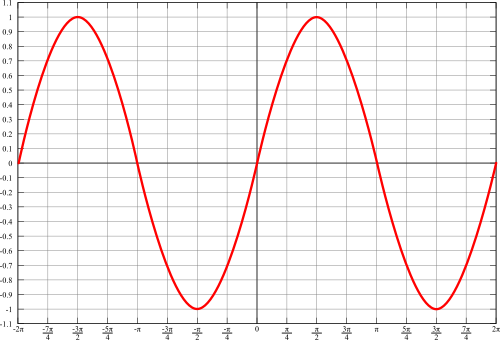
Now to do with sin. Suppose that we have a solution to some equation involving sin where sin(x) = sin(α). Again you have to look at the sine graph for when it repeats itself and where it has lines of symmetry. In fact the sine graph is the same as the cosine graph, just it has been translated to the right by π/2, this means it still repeats every 2π but the line of symmetries are at x = π/2, 3π/2, ...(2n-1)π/2. The first of these mean that when it is an even multiple of π you can find another solution by adding α that is: x = 2πn + α. The second of these mean that whenever it is an odd multiple of π subtracting α gives another solution, that is: x = (2n+1)π + α. To find a range of solutions for sin(x) = sin(α) then x = 2πn + α or 2πn + π + α.  This gives us a general solution to sine function!

And the easiest one of all is finding solutions to tan(x) = tan(α). The tan graph repeats every π and has no lines of symmetry. This simply means that if x = α, it also equals π + α and 2π + α, etc. To find a range of solutions for tan(x) = tan(α) then x = πn + α. This gives a general solution to the tangent function!
That is fine for when you have simple trigonometric equations, but what if you have one that contains more than one trigonometric function? Well there are trigonometric identities that help you to rearrange equations into a form that is easier to solve. I will simply list them in this post, but I will prove them in a later post. For UK readers, next to the identity I will state in which module you need to utilise them in.

- sinӨ/cosӨ = tanӨ; this is required for Core 2 and beyond.
- cos2Ө + sin2Ө = 1; this is required for Core 2 and beyond.
- cosӨ/sinӨ = cotӨ; this is required for Core 3 and beyond.
- tan2Ө + 1 = sec2Ө ; this is required for Core 3 and beyond.
- cot2Ө + 1 = cosec2Ө; this is required for Core 3 and beyond.
- sin(A + B) = sinAcosB + cosAsinB; this is required for Core 4.
- cos(A + B) = cosAcosB - sinAsinB; this is required for Core 4.
- sin(A - B) = sinAcosB - cosAsinB; this is required for Core 4.
- cos(A - B) = cosAcosB + sinAsinB; this is required for Core 4.
- tan(A ± B) = (tanA ± tanB) / (1 ∓ tanAtanB); this is required for Core 4.
- sin2Ө = 2sinӨcosӨ; this is required for Core 4.
- cos2Ө = 1 - 2sin2Ө; this is required for Core 4.
- tan2Ө = 2tanӨ / (1 - 2tan2Ө); this is required for Core 4.
- sin3Ө = 3sinӨ - 4sin3Ө; this is required for Core 4.
- cos3Ө = 4cos3Ө - 3cosӨ; this is required for Core 4.
- tan3Ө = (3tanӨ - tan3Ө) / (1 - 3tan2Ө); this is required for Core 4.

Sunday, 26 February 2012

Introduction to Modular Arithmetic and Congruence

Modular arithmetic is an arithmetic system for the integers where the numbers wrap around, like on a clock for example. The numbers start at one, they go round to twelve and then start again at one, this would be an example of modulo 12. However generally in modular arithmetic we start at 0 and go to 11, before starting at 0 again. This means that 7 o'clock would be 6 mod 12 (mod is often used to shorten modulo). In fact because the number line "wraps around" it means that 19 o'clock = 7 o'clock (as you will know if you have used a 24 hour clock), this means that 18 mod 12 = 6 mod 12; because of this a mod m is wrote where a < m.

However it does not have to be just modulo 12, it can be modulo anything (as long at is a positive integer), so let us jump straight into the definition. So that you are aware of the notation I will use a|b means b divides a (this means that b/a is an integer). Let m be a positive integer and let a, b both be integers if m|a-b then a is congruent to b modulo m, wrote mathematically this is: a ≡ b mod m. Make sure you do not think "≡" means equivalent in this case, because it does not!

You can add in modular arithmetic (provided they have the same modulo). Let m be a positive integer and let a, b,c and d be integers if a ≡ b mod m and c ≡ d mod m then a + c  (b+d) mod m. So basically you add the parts preceding the modulo together and then find modulo m of that.
You may also notice that a/m has a remainder of b, this is how we can quickly work out that 19 o'clock is the same as 7 o'clock, or the same as 103 o'clock. You simple divide the number by the modulo and work out the remainder.

An example of why we would use this using our clock as an example is if it is 4 o'clock now, what will the time be in 157 hours? So what we have is 3 mod 12 and 157 mod 12, adding these together we get 160 mod 12, 160/12 = 13 remainder 4. This means that 160 mod 12 = 4 mod 12, so it will be 5 o'clock 157 hours from 4 o'clock.

This should give you an idea of how to do basic addition with congruences, if you do not understand fully read what I have wrote again and then if you still do not understand, post a comment. Now we have the basic principles in place we can begin to go further. Now we will prove that a mod m + b mod m = (a+b) mod m and also how multiplication works in modular arithmetic.

Multiplication between two congruences is just as easy as addition with congruences, I will first provide a definition to you, before proving it. Let m be a positive integer and let a, b,c and d be integers if a ≡ b mod m and c ≡ d mod m then ac  (bd) mod m; this is the same sort of principle as addition. Now to prove them.

First to prove addition:


Now to prove multiplication:

These are the very basics of congruences, but the are integral to modular arithmetic (I mean, think how important addition and multiplication is normally), they are very, very powerful and I will begin to explore them more and more in my upcoming posts. I will prove just one more result as it is pretty easy and uses multiplication.

The proposition is that an ≡ bn mod m is also true provided  ≡ b mod m and n is a positive integer. We will prove this by induction. Let P(n) be be the statement of the proposition, then P(1) is obviously true as we already know that ≡ b mod m. So let us assume that P(n) is true, then we have that an ≡ bn mod m and that ≡ b mod m, multiplying the two of them together (using our proved method) we get a × an ≡ b × bn mod m, this then simplifies to: an+1 ≡ bn+1 mod m, which is P(n+1). Hence P(n) is true for all values of n!

I hope that you like this post and that is helps you. If you did like it then please also like us on Facebook.