Showing posts with label quantum mechanics. Show all posts

Sunday, 15 July 2012

Understanding the Higgs Boson

Unless you have been hiding under a rock somewhere you will almost certainly have seen the news that the Higgs boson has been 'discovered', I say this tentatively as it has not officially been confirmed just a 'Higgs-like' particle has been observed. But what even is the Higgs boson?

By the 1970s physicists had devised what is known as the "Standard Model" of particle physics - it is a theory of the elementary particles, how they interact with each other and what these interactions mean. The elementary particles can be broken down into two core categories: fermions and bosons. Fermions are matter particles, they are what make protons, atoms, stars and us, whereas bosons are what helps the fermions to "communicate", this communication is called a force.

The standard model predicted the existence of a lot of particles far before they were discovered: the bottom quark, top quark, tau neutrino and the Higgs boson. All of these particles were required for the standard model to work in it's current form. In 1964 Peter Higgs (as well as Robert Brout and Francois Englert) devised a theory (that was later proven) for how elementary particles are able to have mass, this was called the Higgs mechanism.

The Higgs mechanism requires a field pervading through the whole universe and depending on how particles interact with this field dictates what mass they have, this is called the Higgs field. In quantum theory when a field interacts with another object it acts as a particle. In the electromagnetic field this particle is a photon, in the Higgs field the particle is the Higgs boson. The discovery of this particle means that the equations that are currently in place are correct and able to describe every particle we know about and how these particles interact together via the forces incorporated in the standard model (all except gravity), so essentially we now certainly understand the quantum world to a great deal of precision!

The reason the Higgs boson has eluded us for so long is that it is very, very unstable and decays incredibly quickly - in fact it only exists for approximately one zeptosecond, a thousandth of a billionth of a billionth of a second. Because it exists for such a short amount of time you have to observe the after effects of a collision and map how much energy the produced particles have and compare this to what you would expect if a Higgs boson had decayed, the problem is that it can decay into a lot of things. So you have to perform a lot of high energy collisions between particles, observe the data and see if it fits the predictions about how the Higgs boson should behave.

Properties of Higgs Boson:

Mass: 126 GeV/c2 which is equivalent to 2.25 × 10⁻²⁵kg or 134 protons.
It has no electric charge or spin
Read about how the Higgs interacts with other particles

But is this it? Do we understand everything now that we have discovered the long elusive 'God particle' (a terrible, terrible term coined by the media)? The answer is a wonderfully fanatic, no! Thankfully. In fact, the discovery really means that we can now raise more questions and further advance our understanding of everything. At the smallest scale gravity is still a total mystery to us, it is not incorporated into the current standard model at all - one of the most primitive every day forces is still a complete mystery to us! Quantum mechanics and general relativity need to be united before we can even begin to ponder that we understand everything, we are some way off from a theory of everything but the best hat in the ring currently is string theory.

Just as one final note, the Higgs boson has not been officially confirmed as to existing but that a new, previously unknown boson with a mass between 125-127 GeV/c2 that has behaviour "consistent with" a Higgs particle. Further analysis is required to fully confirm it's existence but a very cautious tick is currently next to it!

Sunday, 11 March 2012

Introduction: Differential Equations

Differential Equations have an absolute massive range of uses and are one of the most useful applications from maths to the real world, they have massive influences in: quantum mechanics, electromagnetic equations, biology, economics and an absolute ton more in all of physics; read more about notable differential equations. First I need to explain what a differential equation exactly is. A differential equation is any equation that involves a derivative of any degree, examples of differential equations are:


Differential equations can have different orders, when only the first derivative is present it is a first order differential equation. When there is a second derivative is involved it is said to be a differential equation of the second order. Differential equations of higher orders follow the same pattern for what order it is.

Differential equations can be either linear or non-linear. A differential equation is said to be linear if the highest order derivative of the dependent variable y can be expressed as a linear function of y and the
lower order derivatives. Hence a second order differential equation is said to be linear it must be possible to express it in the form:


To solve a differential equation you wish to find y in terms of x. Some of these are very easy to solve and can be solved by algebra and calculus methods (analytical methods), and you may notice that the first of these examples is very easy to solve and can be solved with calculus. All we need to do is integrate and we will get the answer for all values of y as y = x3 + c. But often it is not that easy to solve and you can not easily express y in terms of x, when this is the case numerical methods are very, very useful.

A numerical method is one that will find approximate solutions to the equation at a point you wish to find. There are a lot of numerical methods to solving differential equations, some more effective that others. I will introduce just the one of these in this post.

Euler's Method for Finding Solutions to Differential Equations
This method was created by the mathematician who seems to have influenced all areas of maths in some way or another, Leonard Euler. If we have some unknown function, but we have what its derivative equals and where one point is on the unknown function then we can find approximate y-values for a point further along the curve.


This method is most effective for small values of h. It can of course be repeated to give a more accurate value for y. If we know a point on some function is (3,5) and we want to find the point 3.4, rather than using a step size of 0.4, we could use one 0.1 and just repeated the algorithm 4 times. This will be more accurate because it will map the graph and it's gradient at each step of 0.1, rather than assuming the graph will have the same gradient the whole time.

This is just an introduction to what differential equations are and one relatively simple method of solving them. If you liked this please like us on Facebook.

Tuesday, 29 March 2011

Imaginary Numbers

When you first begin studying mathematics you are taught that only positive numbers can be square rooted, and this is true for conventional mathematics and it is not too often that you need to square root a negative number; but what if it does arise? How would that even happen?


Well, usually you never really need to square root a negative number. But when plotting quadratic graphs it is always a possibility that the square root of a negative may come up.


You may remember that if b²-4ac < 0 then the quadratic has no real roots, emphasis on the word no real roots. A quadratic equation will always have roots, just imaginary numbers will be involved if b²-4ac < 0.


But what is an imaginary number? It is denoted by the character i and this is representative of √-1. Like all square roots, √-1 has two answers, ±i.


So say, for example we had a quadratic equation where b²-4ac < 0. We could, in fact, solve it. If we had a quadratic equation, 3x²+8x+11=0 we could solve this by completing the square or using the formula, I prefer to complete the square but you would get the same outcome regardless:

If you do not understand this, do not panic! Simply submit a
comment and I will respond, explaining how to do this using
other methods.
Okay, it allows you to discover solutions to previously impossible quadratics, big woop? Well, imaginary numbers are in fact incredibly important! The Schrödinger Equation (the fundamental equation in quantum mechanics) using imaginary numbers. 

The Schrodinger Equation

Engineers also using imaginary numbers as a way to view "phase", this is however denoted by 'j' as 'I' is used for current. Potential energy is also necessary to be seen when carrying out these calculations, this creates a complex number in the form, a+bi, where 'a' and 'b' are integers and 'i' (or 'j'!) is an imaginary number.

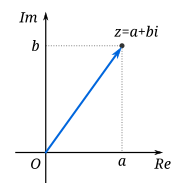
But how are complex numbers represented? They are represented as numbers on a complex plane, with the x-axis being the real axis and the y-axis being the imaginary axis. It is rare that you would find an imaginary number used on its own, it will often be in partnership with another, regular number, as a complex number.
The representation of a complex
 number on a complex plane.
Imaginary Number Facts:
  • You can in fact do xi, it isn't the easiest thing to do, but it is perfectly possible and you will be able to it after a little bit of practice, for the whole breakdown on why please visit my newer blog post: imaginary exponents.
  • Another noteworthy idea is that an imaginary number can also be square rooted! These are roughly (0.707106+0.707106i) and (-0.707106-0.707106i), or as a fraction (1/√2)(1/i) and (-1/√2)(1/i). Try to square them, you will see it works.
  • Imaginary numbers follow a pattern when put to differing powers, this pattern goes: 1, i, -1, -i. You can find out what ix is simply by checking what the remainder is when x is divided by 4. If the remainder is equal to 0 then it will equal i. If it has a remainder of 1 then the answer will be 1, remainder 2 will equal -1 and finally a remainder of 3 will be -i.