
The chain rule is a method of differentiating a function within a function, for example $\sin x^2$. If you have studied maths to a sufficient (but not necessary) level it is likely that you will know that $\begin{align*}\frac{d}{dx}\left(fg(x)\right) = g'(x)f'g(x) \end{align*}$, but you may not know why this is the case.
We know from basic differentiation that $\begin{align*}\frac{d}{dx}(g(x)) = \lim_{h\to 0}\left(\frac{g(x+h) - g(x)}{h}\right) \end{align*}$
Let $\begin{align*}v = \frac{g(x+h) - g(x)}{h} - g'(x)\ (1)\end{align*}$ clearly $v\to 0\ as\ h\to 0$
This idea can be extended to a function of a function, as long as the function is differentiable for some function of $x,\ y$ then as $\begin{align*}\ k\to 0\ ,\ \frac{f(y+k)-f(y)}{k} \to f'(y)\end{align*}$
Let $\begin{align*}w = \frac{f(y+k)-f(y)}{k} - f'(y)\ (2)\end{align*}$ clearly $w\to 0\ as\ k\to 0$
Rearranging $(1)$ and $(2)$ we get:
$\begin{align*}g(x+h) = g(x) + \{g'(x)+v\}h\ (3) \end{align*}$
$\begin{align*}f(y+k) = f(y) + \{f'(y)+w\}k\ (4) \end{align*}$
$\begin{align*}(3) \Rightarrow fg(x+h) = f(g(x) + \{g'(x)+v\}h) \end{align*}$
If we let $k = \{g'(x)+v\}h$ and $y=g(x)$, clearly $k\to0$ as$\ h\to0$
This reduces $(4)$ to$\begin{align*}\ \ f(g(x) + \{g'(x)+v\}h) = fg(x) + \{f'g(x)+w\}\{g'(x)+v\}h \end{align*}$
The left hand side of this statement is equivalent to $fg(x+h)$, we are now in a position to simplify $\begin{align*}\frac{fg(x+h)-fg(x)}{h}\end{align*}$
$\begin{align*}\frac{fg(x+h)-fg(x)}{h} \equiv \frac{fg(x)+\{f'g(x)+w\}\{g'(x)+v\}h - fg(x)}{h} \equiv \{f'g(x)+w\}\{g'(x)+v\}\end{align*}$
We now have a reasonably familiar expression that needs a bit of tweaking to get to the final result.
$\begin{align*}LHS\to\frac{d}{dx}\left(fg(x)\right)\ as\ h\to0\ \therefore\ RHS\to\frac{d}{dx}\left(fg(x)\right)\ as\ h\to0\end{align*}$
As $h\to0\ k,v\to0, w\to0$ as $k\to0$
$\begin{align*}\Rightarrow \lim_{h\to0}\{f'g(x)+w\}\{g'(x)+v\} = g'(x)f'g(x) \end{align*}$
$\begin{align*}\frac{d}{dx}(fg(x)) = g'(x)f'g(x) \end{align*}$
And that is the chain rule! If at any point you do not understand what I have done please leave a comment.
Showing posts with label limits. Show all posts
Showing posts with label limits. Show all posts
Thursday, 21 February 2013

Wednesday, 9 November 2011
Limit of Sin(x)/x at x = 0
First, for those of you that do not know what a limit is, I will begin by defining it in more simple terms before getting into the more complex things. If a series is convergent that means it will tend to a limit. What is a limit? It is a value that a graph will get infinitely close to but will never quite reach. For example the limit as x approaches infinity of 1/x is 0. This can be more concisely denoted as:

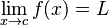
Which means that a broad way to right the limit of anything is:

This is where c is a real number, f(x) a function and L is the limit of that function.
But as my last example shows, it is not just series that can tend to a limit, functions can also have a limit when the function is undefined at a point. In fact limits are vital to such a massive part of mathematics, you will not be able to go into a career or a path within maths without encountering limits. It is so important to calculus that it is required in the proof that an indefinite integral can be reversed by differentiation. If you're interested in that you can read it here.
Now that we have our definition we can begin an explanation of the limit of Sin(x)/x as x approaches 0. The proof is a visual one, so there will be a lot of images to emphasise my explanations.
We will begin by taking the unit circle, a circle with a radius 1 and a centre (0,0), (an equation of x²+y²=1). And begin constructing a variety of triangles, it is much easier to show this as an image. The one thing I must point out is that x in an angle in radians.

The height of the triangle opposite angle using the well known SOHCAHTOA rule can be found to be: Sin(x)/1, which is equivalent to Sin(x). This then means the area of the triangle with base 1 will be; 0.5*1*Sin(x), or Sin(x)/2.
To find the area of the segment of the triangle we will use the formula to find the area of a segment, 0.5*r²*x; r = 1 so we can find the area of the segment to be x/2.
There is one final side we will want to find to find the area of. The height of the largest vertical line. Again using SOHCAHTOA we can find this side to be Tan(x). This then means that the area of this triangle is 0.5*1*Tan(x), or Tan(x)/2.
This then means (as we can see visually) that the green area is less than the red and green area which is less than the blue, red and green area. This then means that: Sin(x)/2 < x/2 < Tan(x)/2. If we times through by 2 this means that, Sin(x) < x < Tan(x). Now if we divide the whole expression by Sin(x) we get Sin(x)/Sin(x) < x/Sin(x) < Tan(x)/Sin(x). Sin(x)/Sin(x) = 1, x/Sin(x) can not be simplified but Tan(x)/Sin(x) can be.
Tan(x) can be represented as Sin(x)/Cos(x), inputting this back into the equation gives us: Sin(x)/Cos(x)/Sin(x) which equals 1/Cos(x). So we now have 1 < x/Sin(x) < 1/Cos(x). You can see we are getting near to Sin(x)/x now, all we need to do is invert the whole expression, this will flip the inequality signs to compensate.
So 1 > Sin(x)/x > Cos(x). Now we will use something called the squeeze theorem to find Sin(x)/x. If we have an inequality a < b < c and a = c, then b must then be equal to both a and c. So we need to find the limit of 1 and Cos(x) as x approaches 0. No matter what x approaches for 1 it will never change from 1, and as x approaches 0 of Cos(x) we get Cos(0) which also equals 0.
This then means that 1 < Sin(x) < 1, so Sin(x) must also equal 1. Our proof is now complete, this therefore means that as x approaches 0 of Sin(x)/x is 1.

If you found my calculations hard to follow in the form of text, look other them below (comments on what is happening are boxed):

This is where c is a real number, f(x) a function and L is the limit of that function.
But as my last example shows, it is not just series that can tend to a limit, functions can also have a limit when the function is undefined at a point. In fact limits are vital to such a massive part of mathematics, you will not be able to go into a career or a path within maths without encountering limits. It is so important to calculus that it is required in the proof that an indefinite integral can be reversed by differentiation. If you're interested in that you can read it here.
Now that we have our definition we can begin an explanation of the limit of Sin(x)/x as x approaches 0. The proof is a visual one, so there will be a lot of images to emphasise my explanations.
We will begin by taking the unit circle, a circle with a radius 1 and a centre (0,0), (an equation of x²+y²=1). And begin constructing a variety of triangles, it is much easier to show this as an image. The one thing I must point out is that x in an angle in radians.
Next we will begin to label the lengths of every side that we possibly can. Anything that is a radius will be 1 (the radius of a unit circle is 1). Once we have that we can begin to use trigonometry to find the values of the other sides.
To find the area of the segment of the triangle we will use the formula to find the area of a segment, 0.5*r²*x; r = 1 so we can find the area of the segment to be x/2.
There is one final side we will want to find to find the area of. The height of the largest vertical line. Again using SOHCAHTOA we can find this side to be Tan(x). This then means that the area of this triangle is 0.5*1*Tan(x), or Tan(x)/2.
 |
| What I have just described is represented visually here with the equations of the shaded shapes listed. |
Tan(x) can be represented as Sin(x)/Cos(x), inputting this back into the equation gives us: Sin(x)/Cos(x)/Sin(x) which equals 1/Cos(x). So we now have 1 < x/Sin(x) < 1/Cos(x). You can see we are getting near to Sin(x)/x now, all we need to do is invert the whole expression, this will flip the inequality signs to compensate.
So 1 > Sin(x)/x > Cos(x). Now we will use something called the squeeze theorem to find Sin(x)/x. If we have an inequality a < b < c and a = c, then b must then be equal to both a and c. So we need to find the limit of 1 and Cos(x) as x approaches 0. No matter what x approaches for 1 it will never change from 1, and as x approaches 0 of Cos(x) we get Cos(0) which also equals 0.
This then means that 1 < Sin(x) < 1, so Sin(x) must also equal 1. Our proof is now complete, this therefore means that as x approaches 0 of Sin(x)/x is 1.
If you found my calculations hard to follow in the form of text, look other them below (comments on what is happening are boxed):

I hope you managed to follow all of that, but if you didn't or you need any further explanation on any part of this please, please comment and I will get back to you.
Sequences and Series
In maths a sequence is an ordered list of numbers called objects, a sequence can be finite, infinite or bi-infinite. A finite sequence is easy to define it is simply a set of finite numbers (for example 1, 3, 5, 7 is a finite sequence); an infinite sequence is slightly harder to picture but it also makes sense, it is simply a sequence that does not terminate at any point (for example the natural numbers start are 1, 2, 3... and will never cease) and a bi-infinite sequence may be a slightly newer concept to try and grasp but it is equally easy to understand, it stretches infinitely in both directions (for example the integers are a bi-infinite sequence ...-2, -1, 0, 1, 2... as it will never cease in either direction).
The sum of a sequence is a series, and this is where the real fun of it all begins to come through with sequences. Often we look to see whether a series is divergent, convergent or oscillating, what this means is whether the series will converge to a limit, if it is divergent it will just get larger and larger in either the positive or negative direction and if a series is oscillating it neither converges to a limit nor diverges to infinity (for example: 1, -1, 1, -1, ... will not converge or diverge, thus it is oscillating).
It is also possible to find the sum of an arithmetic and geometric series (these will be defined later), but first I'll have to introduce some concepts of the symbols used when talking of the sums of numbers. If we have a function, f(x), our first term is, r, and we want to go up to term, n. The way you would usually do this long hand and have to do f(r)+f(r+1)+...+f(n-1)+f(n), but this can be more concisely wrote as:

As you can see this is far easier to write and is just as easy to interpret. But how actually do you find the sum of a series?
For example if we wanted to find the sum to the first 10 natural numbers, 1+2+3+4+5+6+7+8+9+10, what way could we find the answer relatively quickly? Pairing the numbers up first and last, second and second last, etc. will mean each number will be the same so makes an easier calculation. If we do that we get (1+10)+(2+9)+(3+8)+(4+7)+(5+6), which is 11+11+11+11+11 (or better represented as 11*5). So the sum of the first 10 natural numbers is 55.
We can write this short hand by finding out how many pairs their will be and what each one will equal, or S = 0.5n(a+l), where n is the number of terms, a is the first term and l is the last term. Another way of writing this (when we do not know the last term) is that l = a+(n-1)d, if you want an explanation on this please comment. This then means that the sum of an arithmetic series is, S = 0.5n(2a+(n-1)d). **Note that these last two paragraphs only apply to arithmetic series**
We can also find the sum of a geometric sequence (a term starts with 'a' and is the increased by 'r', so the next will be 'ar' and the third will be 'ar²' etc.). This means that the nth term of the sequence will be, arn-1. So to find the sum of a geometric progression, let us consider that Sn = a+ar+ar²+...+arn-1, if we multiply through by r we get rSn = ar+ar²+...+arn, if we take the first from the second we get: Sn-rSn = a-arn, which can be represented as Sn(1-r) = a-arn, dividing through by (1-r) we get the formula for the sum of a geometric progression:

Now we can use this to find the sum to infinity of geometric progression (provided that -1<r<1), it will mean that will arn approach 0 as n approaches infinity, when we have that it becomes easy to find the new equation:

There are also other elements to this general topic, but I think they warrant a topic in their own right. I briefly cover the definition of what a limit is here.
It is also possible to find the sum of an arithmetic and geometric series (these will be defined later), but first I'll have to introduce some concepts of the symbols used when talking of the sums of numbers. If we have a function, f(x), our first term is, r, and we want to go up to term, n. The way you would usually do this long hand and have to do f(r)+f(r+1)+...+f(n-1)+f(n), but this can be more concisely wrote as:
For example if we wanted to find the sum to the first 10 natural numbers, 1+2+3+4+5+6+7+8+9+10, what way could we find the answer relatively quickly? Pairing the numbers up first and last, second and second last, etc. will mean each number will be the same so makes an easier calculation. If we do that we get (1+10)+(2+9)+(3+8)+(4+7)+(5+6), which is 11+11+11+11+11 (or better represented as 11*5). So the sum of the first 10 natural numbers is 55.
We can write this short hand by finding out how many pairs their will be and what each one will equal, or S = 0.5n(a+l), where n is the number of terms, a is the first term and l is the last term. Another way of writing this (when we do not know the last term) is that l = a+(n-1)d, if you want an explanation on this please comment. This then means that the sum of an arithmetic series is, S = 0.5n(2a+(n-1)d). **Note that these last two paragraphs only apply to arithmetic series**
We can also find the sum of a geometric sequence (a term starts with 'a' and is the increased by 'r', so the next will be 'ar' and the third will be 'ar²' etc.). This means that the nth term of the sequence will be, arn-1. So to find the sum of a geometric progression, let us consider that Sn = a+ar+ar²+...+arn-1, if we multiply through by r we get rSn = ar+ar²+...+arn, if we take the first from the second we get: Sn-rSn = a-arn, which can be represented as Sn(1-r) = a-arn, dividing through by (1-r) we get the formula for the sum of a geometric progression:
Subscribe to:
Posts (Atom)