Showing posts with label beauty. Show all posts

Wednesday, 7 December 2011

Riemann Hypothesis

Now I am definitely not an expert in this field, and in fact even the experts aren't really experts in the conventional sense. No one is an expert on it in the conventional sense, it is still unsolved. Over 150 years old and it still remains unsolved not for the lack of trying! In fact it is so important to mathematicians that the Clay Mathematics Institute has put a $1,000,000 bounty on its head (that is, you get $1,000,000 if you manage to solve it).


But what actually is the Riemann Hypothesis? It is a conjecture about the location of the non-trivial zeros of the Riemann Zeta function, it states that all the zeros should lie on the critical strip 0.5+it. "Oh yeah!", I hear you cry, now you get it, obviously. I will explain what this means properly later on in this post. But first I will state what it means. If true it implies a lot of things about the distribution of prime numbers, and as you may or may not know they are very irregular and very difficult to find as the numbers get very, very big.


To track back to my earlier point, what is the Riemann Zeta Function ( it is denoted as ζ(s), ζ being the Greek lower case from which z was derived)?
Where s is an imaginary number, a+ib.
This requires that you understand sequences and series, imaginary numbers and imaginary exponents. The real intrigue of this comes from the fact that it can be represented by Euler's product.
As you may or may not notice this is comprised of the prime numbers, this means that there is a sort of subliminal link between the natural numbers and the prime numbers. This showed that the prime numbers were not just positioned randomly and are not merely the building blocks to numbers but there is an actual link between them and the natural numbers.


The Riemann Zeta Function on its face doesn't look too difficult, I mean it is just an infinite sequence, even with a complex power you'd expect this to be possible and even pretty easy. But that is not the case at all, part of the reason is how sporadic complex exponents can be, and although it is not too difficult to find solutions (using a high powered computer thousands can be found each hour) it is incredibly, incredibly hard to find a proof for all the solutions.
The plot of the Riemann Zeta Function, the red line is the
real part, the blue part is the imaginary part.
You can see, this function seems to have little to no consistency to it, but a fair amount is known about the function. A lot of the zeros do actually satisfy the hypothesis, over 10 trillion of them in fact. And you'd think that is a proof alone, but as it often involves an iterated log (a log of a log, log(log(x)) and this increases very, very, very slowly in fact log(log(10,000,000,000)) = 1, so 10 trillion really isn't anything. If it is still holding true for log(log(x))>40 there may be a greater unanimous opinion on the truth of the hypothesis.


Every mathematician worth his salt has had an encounter with the Riemann Hypothesis and it has withheld every single attempt thus far. The maths used to try and tackle the problem is so complex that entirely new branches of mathematics have been created to deal with it, this maths to laymen has literally nothing, at all, to do with the prime numbers. It is so complex and far away from the problem that it almost boggles mathematicians minds, but it consumes them, it is their passion and life.


Prime numbers are the passion for many and the Riemann Hypothesis is merely an extension of that, and hopefully it will be solved in my life time.


If you have caught the prime number bug I suggest you read the excellent book by Karl Sabbagh called Dr Riemann's Zeros.

Monday, 31 October 2011

Different Sizes of Infinity

Before you read this make sure you have a basic knowledge of sets.

The "cardinality" of something is the size of a set. For example ­the cardinality of the set {3, 2, 17, -9} is 4, and the cardinality of the set {2, 6, -7} is 3. But when thinking it terms of infinity things become more confusing, I mean how can you categorise different sizes of infinity, infinity surely must just be infinity, right?


Well unfortunately, no. Using the ideas of sets we can find that there are actually different cardinalities of infinity. But to find this we need a more general definition of what being the "same sized set" is. A set {1, 2, 3, ..., x-1, x} has a cardinality of x and the set {1, 2, 3, ..., y-1, y} has a cardinality of y, the sets will be the same size if x = y. This then leads to the definition that being the "same size" is if the sets have the same amount of elements.


When we check if a set is the same size as another set, we simply count the number of elements in both sets and compare. But with infinite sets this is (obviously), impossible. But if we break the task down a bit we find ways of managing this. Take the elements from each set and pair them up, if they do match up perfectly with no doubling up or ignoring any elements then the sets are the same size.


Now if we pair the natural numbers, N {1, 2, 3, ...}, and the integers, Z {-2, -1, 0, 1, 2, ...}, we will be able to see which set is larger. We pair the numbers up like so:


And you can see, that despite your better knowledge, the numbers are pairing up and will continue to do perfectly infinitely. This then means that the sets of both the natural numbers and integers are the same size and thus have the same cardinality. This cardinality is referred to as: ℵ0 (read as "aleph null" or "aleph zero"). The aleph, "ℵ", character is used as it is the first letter in the Hebrew word 'infinity'. ℵ0 refers to 'countable infinity', or in simpler terms the lowest possible form of infinity.


When we continue to pair up the numbers we discover that the rational numbers and the natural numbers are too the exact same size and thus the cardinality of the rational numbers is also ℵ0. In fact the prime numbers are also deemed to have the same cardinality as the natural numbers, integers and rational numbers. I know it seems insane, but it is true.

And going back to my earlier point there are larger cardinalities of infinity. As you would think the next cardinality of infinity is ℵ1. The size of the real numbers in fact are larger that the natural numbers, integers, etc., this is because the real numbers (in now way at all) can be paired to the natural numbers. Because, between 0 and 1 there an infinite number of real values that are there, in fact the same can be said between 0 and 0.000000001. Thinking of it in this way helps to visualise the fact that the set of real numbers must be larger than the set of natural numbers.


As far as ℵx goes it will exist as long as x is a natural number, but as x goes past 1 it becomes much harder to visualise how this infinity is larger than the last. But there can not be ℵ1.5 for example, this is the continuum hypothesis.

Friday, 4 March 2011

Pascal's Triangle

Pascal's Triangle has it's roots far before Blaise Pascal arranged it in the trangular form we all know (and love?) today, but what actually is Pascal's Triangle, why's it useful and what are it's properties?

The first 13 rows of the triangle are listed above, but what is there that we can notice? Well each number is the sum of the two directly above it, and that is the key to constructing a Pascal Triangle of your own. Other than creating some very interesting and intriguing patterns, some of which I will explain...

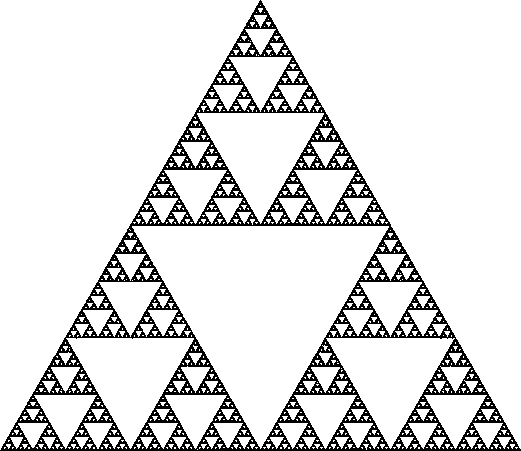
Line one is the diagonal line of ones, line two is the counting numbers. The next line (the third line) is the triangle numbers. Here's where it gets even more fascinating, and quite frankly beautiful; if you shade the even numbers with one colour and the odd numbers with another colour you end up with Sierpinski's Triangle, which looks like...

And as you can see, it's actually quite a wonderful piece of art, surely this is the epitome of eloquence within Maths?

For the more Mathematical minded among us you may find it more eloquent that each row of the triangle adds to be 2^(n-1), n being the row number. Another use of Pascal's Triangle? Showing the coefficients in the binomial expansion. Say we choose (x+1)^4, if we look at Pascals Triangle we can see that the coefficients will be: 1 4 6 4 1. The actual expansion is; x^4+4x^3+6x^2+4x+1, can you also see a pattern here? But that's another post for another time...

This surely is the definition of beauty within Maths, how intricate a very simple piece of Maths can become.

I'd like to see what you can do now though, show me your best Pascal Triangles or Sierpinski Triangles in the comments or tag me in a post on my twitter: http://twitter.com/#!/EloquentMath

Sunday, 27 February 2011

The beginning...

I will not begin my blog by boring the undoubted hundreds and thousands of you reading this (-ahem), but just start with a small little speech.

If you take a brief moment to sit back and think about the world, the universe, in which we live you will be simply amazed at the sheer size and beauty of which it possesses. And yet, not a single part of the wondrous magnitude of it all could be explained, conceived or created without basic and of course advanced Mathematics.

To try and explain everything, you will need Maths! And that is what fascinates me, how, in its complexness it is so simple, and yet so huge and daunting. I hope that if you read this you too are beginning to be inspired, or already are inspired, into a radiant love of the world of Mathematics.