Showing posts with label imaginary numbers. Show all posts

Wednesday, 7 December 2011

Riemann Hypothesis

Now I am definitely not an expert in this field, and in fact even the experts aren't really experts in the conventional sense. No one is an expert on it in the conventional sense, it is still unsolved. Over 150 years old and it still remains unsolved not for the lack of trying! In fact it is so important to mathematicians that the Clay Mathematics Institute has put a $1,000,000 bounty on its head (that is, you get $1,000,000 if you manage to solve it).


But what actually is the Riemann Hypothesis? It is a conjecture about the location of the non-trivial zeros of the Riemann Zeta function, it states that all the zeros should lie on the critical strip 0.5+it. "Oh yeah!", I hear you cry, now you get it, obviously. I will explain what this means properly later on in this post. But first I will state what it means. If true it implies a lot of things about the distribution of prime numbers, and as you may or may not know they are very irregular and very difficult to find as the numbers get very, very big.


To track back to my earlier point, what is the Riemann Zeta Function ( it is denoted as ζ(s), ζ being the Greek lower case from which z was derived)?
Where s is an imaginary number, a+ib.
This requires that you understand sequences and seriesimaginary numbers and imaginary exponents. The real intrigue of this comes from the fact that it can be represented by Euler's product.
As you may or may not notice this is comprised of the prime numbers, this means that there is a sort of subliminal link between the natural numbers and the prime numbers. This showed that the prime numbers were not just positioned randomly and are not merely the building blocks to numbers but there is an actual link between them and the natural numbers.


The Riemann Zeta Function on its face doesn't look too difficult, I mean it is just an infinite sequence, even with a complex power you'd expect this to be possible and even pretty easy. But that is not the case at all, part of the reason is how sporadic complex exponents can be, and although it is not too difficult to find solutions (using a high powered computer thousands can be found each hour) it is incredibly, incredibly hard to find a proof for all the solutions.
The plot of the Riemann Zeta Function, the red line is the
real part, the blue part is the imaginary part.
You can see, this function seems to have little to no consistency to it, but a fair amount is known about the function. A lot of the zeros do actually satisfy the hypothesis, over 10 trillion of them in fact. And you'd think that is a proof alone, but as it often involves an iterated log (a log of a log, log(log(x)) and this increases very, very, very slowly in fact log(log(10,000,000,000)) = 1, so 10 trillion really isn't anything. If it is still holding true for log(log(x))>40 there may be a greater unanimous opinion on the truth of the hypothesis.


Every mathematician worth his salt has had an encounter with the Riemann Hypothesis and it has withheld every single attempt thus far. The maths used to try and tackle the problem is so complex that entirely new branches of mathematics have been created to deal with it, this maths to laymen has literally nothing, at all, to do with the prime numbers. It is so complex and far away from the problem that it almost boggles mathematicians minds, but it consumes them, it is their passion and life.


Prime numbers are the passion for many and the Riemann Hypothesis is merely an extension of that, and hopefully it will be solved in my life time.


If you have caught the prime number bug I suggest you read the excellent book by Karl Sabbagh called Dr Riemann's Zeros.

Saturday, 26 November 2011

Euler's Formula

As I mentioned in my previous post on imaginary exponents (read that here), I would explain why in fact Euler's beautiful and immense formula actually works. First of all, I'll actually say what the formula is:
eix = Cos(x)+iSin(x)

But this is not exactly intuitive why this is the case. The answer lies in a brilliant piece of maths devised by Brook Taylor, it is called the Taylor series. You can represent any function as the sum of an infinite series of polynomials. This is incredibly useful when it comes to Sin(x), Cos(x) and ex, and when you delve into the Taylor series of these you can begin to see where eix = Cos(x)+iSin(x) comes from:


Now, it might not be immediately obvious how those are related, but all the right terms are there we just need to piece it together. If we begin to manipulate the Taylor series for ex and we replace 'x' with 'ix' we will begin to see our proof. For the purposes of this I must mention how ix works i1 = i, i2 = -1, i3 = -i, i4 = 1, i5 = i,... and it continues in this fashion for all integer powers of i.


Now we have that e^ix = (1 - x^2/2!+ x^4/4!- ((x^6)/6!)+ ...) + i (x - x^3/3!+ (x^5/5!)- x^7/7!+ ...), and these look awfully familiar. In fact if I refer you back to the Taylor series' of Cos(x) and Sin(x):


You can see that these are apparent in what we have now discovered  eix to equal. This then means that:


And hence we have our proof of Euler's formula and that eix = Cos(x)+iSin(x).

You may have also seen Euler's formula in action as Euler's identity which is often described as the most beautifully profound equation in maths. Euler's identity is eiπ + 1 = 0, and it is so beautiful because it incorporates the five most important numbers in maths: π, e, 1, 0 and i.

Why does eiπ + 1 = 0? Well if we look at our proof of Euler's formula, eix = Cos(x)+iSin(x) and we input π we get: eiπ = Cos(π)+iSin(π). Sin(π) = 0, Cos(π) = -1. Therefore  eiπ = -1, so  eiπ + 1 = 0.

Imaginary Exponents: x^i

To learn how we do this I first need to explain a very, very useful mathematical formula. It is called "Euler's formula", and this formula gives us a way to find the value of the imaginary exponential function (e^ix) using methods that we already have well defined and are easy to deal with. Euler's formula is: e^ix = Cos(x)+iSin(x), where x is an angle in radians. I may do a post on the actual maths behind why this is the case, but for the purpose of this post it has no relevance.


Now, we can find e^ix, but what use is this if we want to find 2^i, i^i or just anything raised to the power of i, let's call this a^i. So, we want to find a^x where x = i, so we need to try and remember a^x as something involving e raised to the power of something. So this means we have, a^x = e^y.
This then means that a^x = e^[xln(a)]. So we now have a^x in a form involving e raised to a power. So now we can input when x = i. Now by simply placing this into the equation we get, a^i = e^[i*ln(a)]. We can then turn this into something we can solve using Euler's formula, e^[i*ln(a)] = Cos[ln(a)]+iSin[ln(a)].
So now to actually input some numbers to this. Let's say I want to find 2^i, so from our previously defined formula we now have that: e^[i*ln(2)] = Cos[ln(2)]+iSin[ln(2)]. Using our calculators we will find that this is roughly Cos(0.693147)+iSin(0.693147), which then equates to roughly 0.76924+0.63896i. So 2^i ≈ 0.76924+0.63896i

As you can see, this is a complex number and it will be a lot of the time when we deal with imaginary exponents, but (as you may have thought) there are times when the solution to a^i will be a real answer. This is when iSin(x) = 0, and this will happen at Sin(x) = 0 and if you know your Sine curves you will know that this is at Sin(kπ), where k is any integer. Using our formula derived from Euler's, e^[i*ln(a)] = Cos[ln(a)]+iSin[ln(a)], we can see that if a^i is a real number, ln(a) = kπ. If we make both sides to the power of e, we can clear our logarithm to get: a = e^kπ. This should also then mean that the solution that is real (where a = e^kπ) should be equivalent to Cos(kπ).

Therefore if this is correct, then (e^3π)^i should produce a real value. (e^3π)^i = Cos[ln(e^3π)]+iSin[ln(e^3π)]. And when you do work this out, low and behold you get the answer of -1 (which incidentally is the same as Cos(3π)).

Saturday, 29 October 2011

Modulus

You may or may not be aware of what modulus is. If you have come across the modulus (absolute value) of a number before it is likely to only be of real numbers. The notation for the modulus of x is, |x|.

If the number is just a real number then calculating the modulus is incredibly easy and requires no thought. Essentially it is just 'taking the positive value' of the number, for example: |5| is simply 5, and |-3| = 3. It follows that any rational or irrational real number is just the positive value of it. The definition of |x| for any real value of x therefore follows that |x| = (x²).

Another, potentially easier way to think of the modulus of a number, is to think of the numbers distance from 0 on a number line. -5 is 5 units away from 0 and 5 is also 5 units away from 0. This thought is useful when it comes to finding the modulus of a complex number.

Complex numbers can also be represented (in a way) on a number line, they are represented in a two-dimensional complex plane. A complex number, 5+3i will be 5 units in the x direction and 3 units in the y direction, therefore the general form of a complex number is x+iy.

As I said previously, to find the modulus of a complex number it helps if we think of our previous definition of |x| being the distance from 0 on a number line (or a complex plane, in this case). If we think of it in this manner then simple co-ordinate geometry states that the distance from 0 to x+iy is √[(x-0)²+(y-0)²], or simply the general definition of |x+iy| = (x²+y²).

|x| = (x²) when x is a real number, and this able to be proved from our new definition of |x+iy|. |x+iy| = (x²+y²), and when x+iy is a real number, y has to equal 0, plugging this into the equation we get |x+i0| = (x²+0²), therefore |x| = (x²), proved.

If any of this was explained poorly or just went straight over your head please comment and I will do everything I can to make it understandable. Also if you would like more information on imaginary numbers please visit an older post of mine here.

Tuesday, 29 March 2011

Imaginary Numbers

When you first begin studying mathematics you are taught that only positive numbers can be square rooted, and this is true for conventional mathematics and it is not too often that you need to square root a negative number; but what if it does arise? How would that even happen?


Well, usually you never really need to square root a negative number. But when plotting quadratic graphs it is always a possibility that the square root of a negative may come up.


You may remember that if b²-4ac < 0 then the quadratic has no real roots, emphasis on the word no real roots. A quadratic equation will always have roots, just imaginary numbers will be involved if b²-4ac < 0.


But what is an imaginary number? It is denoted by the character i and this is representative of -1. Like all square roots, -1 has two answers, ±i.


So say, for example we had a quadratic equation where b²-4ac < 0. We could, in fact, solve it. If we had a quadratic equation, 3x²+8x+11=0 we could solve this by completing the square or using the formula, I prefer to complete the square but you would get the same outcome regardless:

If you do not understand this, do not panic! Simply submit a
comment and I will respond, explaining how to do this using
other methods.
Okay, it allows you to discover solutions to previously impossible quadratics, big woop? Well, imaginary numbers are in fact incredibly important! The Schrödinger Equation (the fundamental equation in quantum mechanics) using imaginary numbers. 

The Schrodinger Equation

Engineers also using imaginary numbers as a way to view "phase", this is however denoted by 'j' as 'I' is used for current. Potential energy is also necessary to be seen when carrying out these calculations, this creates a complex number in the form, a+bi, where 'a' and 'b' are integers and 'i' (or 'j'!) is an imaginary number.

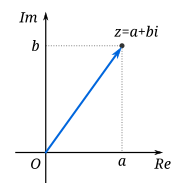
But how are complex numbers represented? They are represented as numbers on a complex plane, with the x-axis being the real axis and the y-axis being the imaginary axis. It is rare that you would find an imaginary number used on its own, it will often be in partnership with another, regular number, as a complex number.
The representation of a complex
 number on a complex plane.
Imaginary Number Facts:
  • You can in fact do xi, it isn't the easiest thing to do, but it is perfectly possible and you will be able to it after a little bit of practice, for the whole breakdown on why please visit my newer blog post: imaginary exponents.
  • Another noteworthy idea is that an imaginary number can also be square rooted! These are roughly (0.707106+0.707106i) and (-0.707106-0.707106i), or as a fraction (1/√2)(1/i) and (-1/√2)(1/i). Try to square them, you will see it works.
  • Imaginary numbers follow a pattern when put to differing powers, this pattern goes: 1, i, -1, -i. You can find out what ix is simply by checking what the remainder is when x is divided by 4. If the remainder is equal to 0 then it will equal i. If it has a remainder of 1 then the answer will be 1, remainder 2 will equal -1 and finally a remainder of 3 will be -i.