
You may or may not be aware of what modulus is. If you have come across the modulus (absolute value) of a number before it is likely to only be of real numbers. The notation for the modulus of x is, |x|.
If the number is just a real number then calculating the modulus is incredibly easy and requires no thought. Essentially it is just 'taking the positive value' of the number, for example: |5| is simply 5, and |-3| = 3. It follows that any rational or irrational real number is just the positive value of it. The definition of |x| for any real value of x therefore follows that |x| = √(x²).
Another, potentially easier way to think of the modulus of a number, is to think of the numbers distance from 0 on a number line. -5 is 5 units away from 0 and 5 is also 5 units away from 0. This thought is useful when it comes to finding the modulus of a complex number.
Complex numbers can also be represented (in a way) on a number line, they are represented in a two-dimensional complex plane. A complex number, 5+3i will be 5 units in the x direction and 3 units in the y direction, therefore the general form of a complex number is x+iy.
As I said previously, to find the modulus of a complex number it helps if we think of our previous definition of |x| being the distance from 0 on a number line (or a complex plane, in this case). If we think of it in this manner then simple co-ordinate geometry states that the distance from 0 to x+iy is √[(x-0)²+(y-0)²], or simply the general definition of |x+iy| = √(x²+y²).
|x| = √(x²) when x is a real number, and this able to be proved from our new definition of |x+iy|. |x+iy| = √(x²+y²), and when x+iy is a real number, y has to equal 0, plugging this into the equation we get |x+i0| = √(x²+0²), therefore |x| = √(x²), proved.
If any of this was explained poorly or just went straight over your head please comment and I will do everything I can to make it understandable. Also if you would like more information on imaginary numbers please visit an older post of mine here.
Showing posts with label complex. Show all posts
Showing posts with label complex. Show all posts
Saturday, 29 October 2011

Tuesday, 29 March 2011
Imaginary Numbers
When you first begin studying mathematics you are taught that only positive numbers can be square rooted, and this is true for conventional mathematics and it is not too often that you need to square root a negative number; but what if it does arise? How would that even happen?
Well, usually you never really need to square root a negative number. But when plotting quadratic graphs it is always a possibility that the square root of a negative may come up.
You may remember that if b²-4ac < 0 then the quadratic has no real roots, emphasis on the word no real roots. A quadratic equation will always have roots, just imaginary numbers will be involved if b²-4ac < 0.
But what is an imaginary number? It is denoted by the character i and this is representative of √-1. Like all square roots, √-1 has two answers, ±i.
So say, for example we had a quadratic equation where b²-4ac < 0. We could, in fact, solve it. If we had a quadratic equation, 3x²+8x+11=0 we could solve this by completing the square or using the formula, I prefer to complete the square but you would get the same outcome regardless:
Okay, it allows you to discover solutions to previously impossible quadratics, big woop? Well, imaginary numbers are in fact incredibly important! The Schrödinger Equation (the fundamental equation in quantum mechanics) using imaginary numbers.
Well, usually you never really need to square root a negative number. But when plotting quadratic graphs it is always a possibility that the square root of a negative may come up.
You may remember that if b²-4ac < 0 then the quadratic has no real roots, emphasis on the word no real roots. A quadratic equation will always have roots, just imaginary numbers will be involved if b²-4ac < 0.
But what is an imaginary number? It is denoted by the character i and this is representative of √-1. Like all square roots, √-1 has two answers, ±i.
So say, for example we had a quadratic equation where b²-4ac < 0. We could, in fact, solve it. If we had a quadratic equation, 3x²+8x+11=0 we could solve this by completing the square or using the formula, I prefer to complete the square but you would get the same outcome regardless:
 |
| If you do not understand this, do not panic! Simply submit a comment and I will respond, explaining how to do this using other methods. |
 |
| The Schrodinger Equation |
Engineers also using imaginary numbers as a way to view "phase", this is however denoted by 'j' as 'I' is used for current. Potential energy is also necessary to be seen when carrying out these calculations, this creates a complex number in the form, a+bi, where 'a' and 'b' are integers and 'i' (or 'j'!) is an imaginary number.
But how are complex numbers represented? They are represented as numbers on a complex plane, with the x-axis being the real axis and the y-axis being the imaginary axis. It is rare that you would find an imaginary number used on its own, it will often be in partnership with another, regular number, as a complex number.
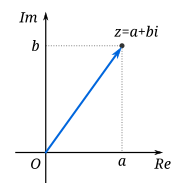 |
| The representation of a complex number on a complex plane. |
Imaginary Number Facts:
- You can in fact do xi, it isn't the easiest thing to do, but it is perfectly possible and you will be able to it after a little bit of practice, for the whole breakdown on why please visit my newer blog post: imaginary exponents.
- Another noteworthy idea is that an imaginary number can also be square rooted! These are roughly (0.707106+0.707106i) and (-0.707106-0.707106i), or as a fraction (1/√2)(1/i) and (-1/√2)(1/i). Try to square them, you will see it works.
- Imaginary numbers follow a pattern when put to differing powers, this pattern goes: 1, i, -1, -i. You can find out what ix is simply by checking what the remainder is when x is divided by 4. If the remainder is equal to 0 then it will equal i. If it has a remainder of 1 then the answer will be 1, remainder 2 will equal -1 and finally a remainder of 3 will be -i.
Subscribe to:
Posts (Atom)